

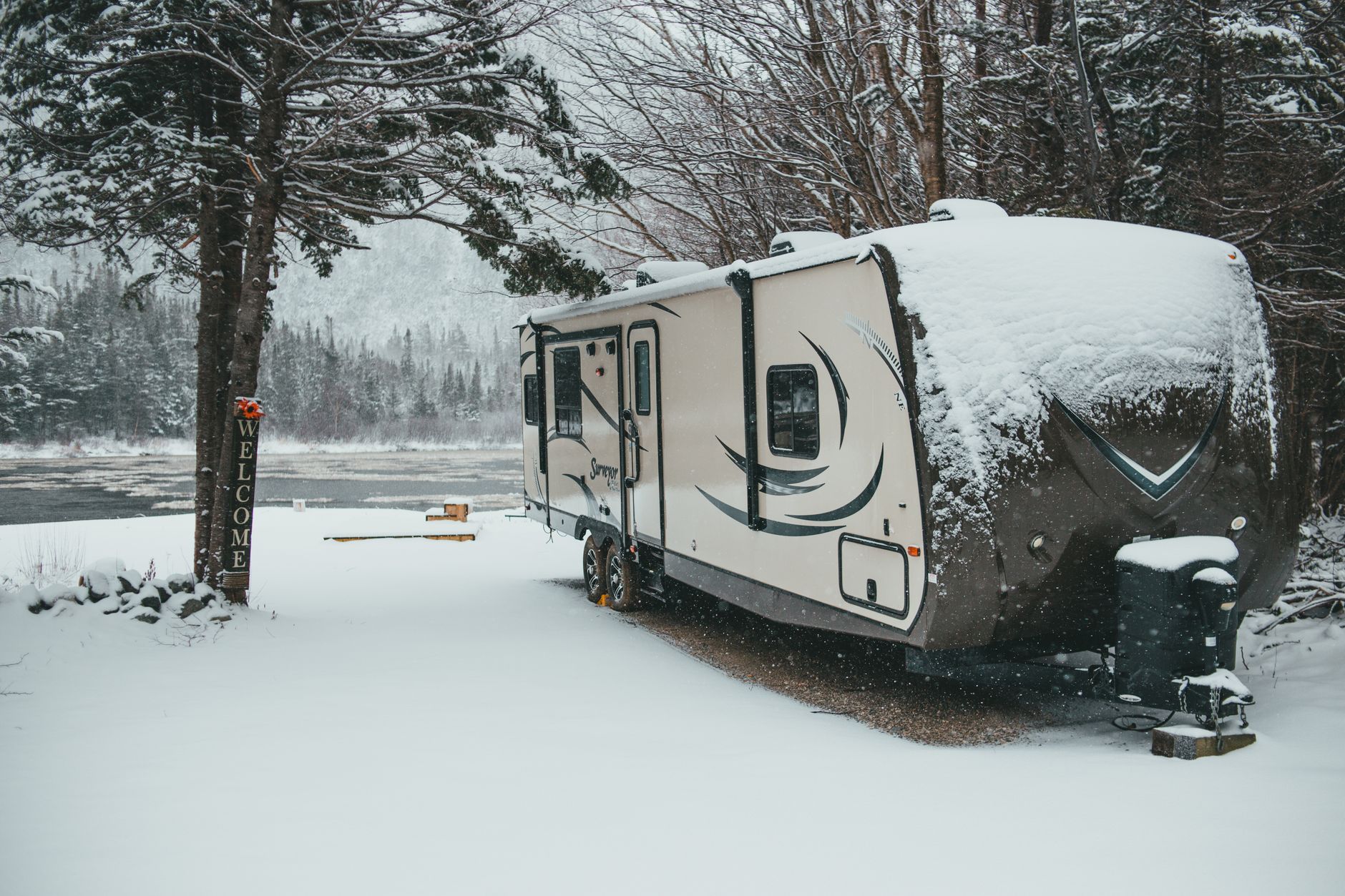
Photo by Erik Mclean on Pexels
Living in an RV during sustained sub-freezing weather requires a coordinated freeze-prevention strategy. Surviving prolonged freezing temperatures without burst plumbing or frozen holding tanks comes down to three operational priorities: eliminating under-chassis wind chill with a sealed skirting system, keeping fresh and waste water lines ice-free, and running your heating systems so warm air continuously reaches the enclosed underbelly.
Whether you are stationary for the season or navigating winter as part of your year-round RV living journey, standard three-season habits quickly fail below 32°F. Here is how to configure your rig's exterior and interior systems for reliable cold-weather protection.
The Physics of RV Skirting: Convective Heat Loss vs. Pure R-Value
Many RVers assume the primary job of skirting is to wrap the rig in the highest possible R-value insulation. In reality, skirting protects your RV underbelly primarily by eliminating convective heat loss rather than stacking thermal mass.
When freezing wind sweeps beneath an unskirted RV, it rapidly strips radiant heat away from the underbelly Coroplast, exposed gate valves, and low-point drains. A properly installed skirt creates a sealed perimeter that traps a dead-air buffer pocket beneath the floor. While skirting alone does not generate heat, blocking the wind significantly slows thermal transfer and prevents the extreme wind-chill effect that causes rapid line freezes.
Comparing RV Skirting Materials: Foam Board, Vinyl, and Inflatables
Selecting the right skirting material depends on your budget, whether your setup is stationary or mobile, and how frequently you relocate.
| Skirting Type | Upfront Cost | Thermal Performance | Packability & Portability | Best Use Case |
|---|---|---|---|---|
| Extruded Polystyrene (XPS) | Lowest | ~R-5 per inch | Very Low (Rigid & bulky) | Stationary seasonal parking |
| Reinforced Vinyl (e.g., EZ-Snap) | Moderate to High | Low R-value; high air seal | High (Folds compactly) | Mobile and recurring winter travel |
| Inflatable Systems (e.g., AirSkirts) | Highest | Moderate air barrier | High (Deflates into storage bags) | Frequent travel; zero-drill setups |
1. Extruded Polystyrene (XPS) Rigid Foam Board
Rigid XPS foam boards (typically 1 to 2 inches thick) provide roughly R-5 of thermal resistance per inch at a low upfront materials cost. The panels can be custom-cut to hug the RV contour and taped together at the seams.
- Limitations: XPS is bulky, fragile, and practically impossible to pack inside a travel trailer or motorhome for transit. It is strictly viable for stationary RVers staying in one location all winter. Additionally, foam board is flammable and prone to snapping or blowing out in severe winter wind gusts if not heavily anchored with framing or ground weights.
2. Heavy-Duty Reinforced Vinyl Skirting
Custom or semi-custom reinforced vinyl skirting systems, such as EZ-Snap, use durable, puncture-resistant fabric cut to your RV's profile. These systems often attach to the lower exterior sidewalls using no-drill fastener studs backed with 3M VHB adhesive.
- Limitations: While vinyl packs down small for travel and withstands heavy weather, the installation must be planned ahead. Fastener adhesives such as 3M VHB require warm application temperatures (typically 60°F or higher) to achieve a full structural bond. Applying these adhesives in freezing weather often causes premature fastener failure.
3. Inflatable Skirting Tubes
Systems like AirSkirts utilize heavy-gauge PVC inflatable tubes placed directly beneath the RV's perimeter. When inflated, the tubes expand to press tightly against the ground and the RV undercarriage, creating an airtight seal without screws, track channels, or adhesive tape.
- Limitations: Inflatable systems offer the fastest setup and pack down small, but they require a significantly higher upfront equipment investment compared to DIY foam board.
Freeze-Proofing Water Supply: Heated Hoses vs. the Fill-and-Stow Method
Fresh water lines and sewer connections represent the most vulnerable failure points in sub-freezing weather.
Commercial Heated Hoses and Connection Traps
Commercial heated drinking water hoses (such as the Camco Freeze BAN) feature an integrated, self-regulating heat cable protected by an insulated outer jacket. These hoses are commonly rated for operation between -20°F and -40°F.
However, a heated hose only protects the length of the hose itself. The most common freeze-up occurs at the unheated connection points:
- The Campground Hydrant: The brass hydrant sticking out of the ground will freeze if left uninsulated, even if your hose heating element is fully powered.
- The City Water Inlet: The brass elbow and plastic inlet fitting on your RV's utility bay will freeze from exposure.
To prevent connection failures, wrap self-regulating heat tape around the exposed hydrant, spigot, and RV inlet elbow, then cover those assemblies in closed-cell foam pipe insulation or an insulated faucet pouch.
The Fill-and-Stow Alternative
If you prefer not to monitor external heat tape or rely on continuous 120-volt power for an external water line, use the fill-and-disconnect method:
- Hook up a standard drinking water hose when water is needed.
- Fill the onboard fresh water holding tank completely.
- Immediately disconnect the hose, drain all standing water from it, and stow it inside a heated storage bay or your RV living area.
- Run your internal plumbing via the RV's onboard 12-volt water pump.
This method completely eliminates the risk of a burst city water line or a frozen campground hydrant overnight.
Waste Valves: Preventing the "Ice Pyramid"
Never leave your black or gray sewer termination valves open during freezing weather, even when connected to full sewer hookups. If a valve is left open, small trickles of liquid waste lose thermal mass in the unheated sewer hose, freezing layer by layer. Over several days, this forms a solid ice blockage known as an "ice pyramid" inside the sewer discharge pipe, which is exceptionally difficult to clear without damaging the plumbing.
Keep both dump valves firmly closed. Allow the holding tanks to fill to at least two-thirds capacity, then open the valves to dump full, rapid flushes before closing them immediately.
RV Heating Strategy: Avoiding the Space Heater Underbelly Trap
Portable electric space heaters are popular for supplementing warmth and saving propane, but using them incorrectly creates a major plumbing hazard.
Why Relying Only on Space Heaters Freezes the Underbelly
Even on rigs equipped with factory 'Arctic Packages' or 'Four-Season' ratings, enclosed underbellies rely on active, ducted airflow from the primary propane furnace (such as a Suburban or Dometic unit) to prevent the fresh tank, gray/black tanks, and low-point drains from freezing.
If you place portable electric space heaters throughout your interior living area, the indoor ambient temperature will satisfy the wall thermostat. As a result, the primary propane furnace never cycles on. While your living room stays warm, no heated air reaches the underbelly Coroplast, leading to frozen and burst water lines below the floorboards. Always maintain a baseline run cycle on your ducted propane furnace during sub-freezing weather, supplemented by your 12-volt tank heating pads.
Propane Supply Management: Sizing Tanks and Using 4-Port Tees
A typical 20,000 to 40,000 BTU RV propane furnace consumes roughly one-third of a gallon of liquid propane for every hour of continuous burn time. In deep sub-freezing conditions, a furnace may run continuously, burning through a standard 20-pound propane cylinder (4.7 gallons) in 24 to 48 hours.
Hauling standard 20-pound or 30-pound cylinders for daily refills is inefficient. Stationary or long-term winter RVers should install an external 4-port propane brass tee adapter (such as a Camco Extend-A-Stay or Stay-A-While) between the RV container valve and the main regulator. This allows you to hook up an external 100-pound (23.6-gallon) cylinder or schedule large-tank bulk delivery directly to your site without breaking camp or moving the rig.
Critical Sub-Zero Safety: Exhaust Clearances and Combustion Hazards
Enclosing the space beneath an RV introduces distinct safety requirements that must be handled properly:
- Maintain Clear Exterior Flues and Exhausts: Never run skirting material over your furnace exhaust outlet, water heater vent, or generator exhaust pipe. These combustion exhausts produce deadly carbon monoxide (CO) and extreme heat. They must vent cleanly into open air away from the skirting envelope.
- Avoid Unvented Open-Flame Heaters: Never place portable, unvented propane heaters (such as Mr. Heater Buddy units) inside the sealed skirting cavity under your RV to warm the floor. Open-flame heaters under a skirt create an acute fire hazard and can direct carbon monoxide up through floor penetrations into the living space. Avoid using unvented propane heaters unmonitored overnight inside the RV due to carbon monoxide and excessive moisture buildup.
- Test Safety Detectors: Ensure carbon monoxide and LP gas detectors are fully operational, tested, and within their service life before entering cold-weather conditions, alongside your regular RV maintenance routine.
Frequently Asked Questions
Why does blocking wind underneath the RV protect tanks better than high-R-value materials?
Wind creates forced convection, which strips heat away from exposed water lines and holding tank bottoms far faster than still air. By stopping wind penetration, a skirt traps a pocket of dead air that acts as a thermal buffer, stabilizing temperatures under the chassis even with thin skirt material.
Can I survive freezing weather using only electric space heaters?
No. Standard RV furnaces push warm air directly through ductwork into the enclosed underbelly to protect holding tanks, valves, and water pipes. If electric space heaters warm the living space enough to keep the furnace thermostat from calling for heat, underbelly airflow stops completely, allowing plumbing below the floor to freeze.
How does an Extend-A-Stay propane tee work?
An Extend-A-Stay (or Stay-A-While) adapter is a brass 4-port tee installed inline between your RV's onboard propane tank valve and its two-stage pressure regulator. It provides an auxiliary inlet port that lets you hook up an external, high-capacity propane cylinder (such as a 100-pound tank) to fuel your onboard appliances without moving the RV.
Why do heated water hoses still freeze at the spigot?
A heated drinking water hose only generates heat along the length of the hose itself. The unheated brass campground hydrant and the RV's external city water inlet elbow remain completely exposed to ambient temperatures and wind chill. Unless you wrap those fittings with self-regulating heat tape and insulation, water will freeze at the metal connection points.
Should I leave my gray tank valve open when it is below freezing?
No. Leaving waste valves open allows small trickles of water to freeze in layers along the unheated sewer hose. This buildup eventually creates a solid "ice pyramid" that clogs the hose and discharge outlet. Keep gray and black valves closed until the tanks are at least two-thirds full, dump them completely in a rapid flow, and close them immediately.
Key Takeaways for Sub-Freezing RV Stays
Thriving in an RV during sub-zero conditions requires managing heat retention and airflow in equal measure. Stop convective heat loss by sealing your underbelly perimeter with the right skirting system for your travel profile. Protect your plumbing by either insulating every exposed water fitting or adopting the zero-risk fill-and-stow method. Most importantly, run your primary ducted furnace to force warm air beneath the floorboards, back it up with adequate propane capacity via an external tee, and keep all combustion exhausts unobstructed for a safe, warm winter.